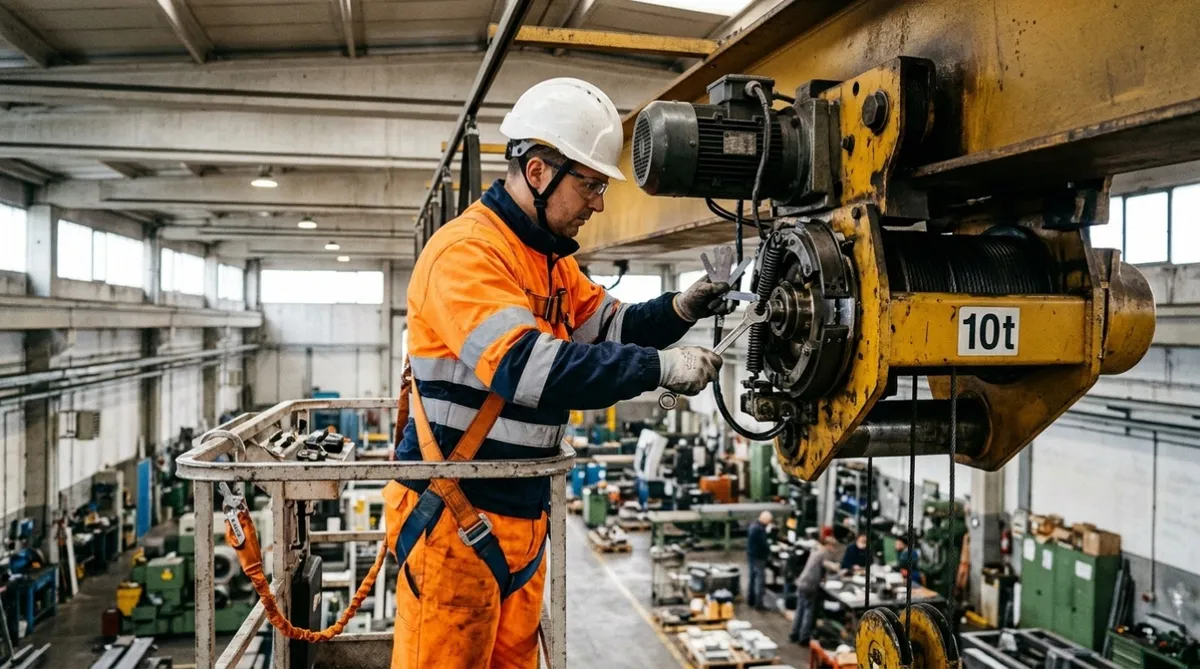
Customer Request & Reported Problem
The customer requested an <strong>emergency service call to resolve a breakdown on a 10 Ton overhead crane</strong>. During regular load handling operations in the factory, a hazardous fault was identified: <strong>the hoisting hook kept descending even after the operator released the control button</strong> (failure to achieve immediate mechanical holding).
This operating condition prevented safe component positioning and posed an acute risk of dropped loads or crushing hazards for floor personnel.
Description of the Technical Work Performed
After cordoning off the work zone and isolating the crane electrical supply via lockout/tagout procedures, our technician accessed the machinery at height using an <strong>electric mobile elevating work platform (MEWP)</strong> equipped with Category III fall arrest PPE.
Following diagnostic gauge inspections on the hoist trolley, an <strong>electromechanical hoisting brake malfunction</strong> caused by excessive air gap clearance was confirmed. The technician performed <strong>precision air gap and brake lining adjustment</strong> to OEM manufacturer tolerances, restoring spring tension and immediate holding response.
Technical Notes & Recommendations
Overhead crane hoisting brakes utilize friction material (linings) subject to continuous mechanical wear during every duty cycle. This assembly requires scheduled adjustments: regular preventative maintenance prevents reaching the critical drift stage, ensuring maximum operational safety and zero unplanned factory downtime.
Please note that the adjustment performed during this service represents the <strong>final available stroke limit</strong> on the mechanical wear compensator. At the very next sign of wear, no further calibration will be possible: <strong>mandatory replacement of the brake lining or complete brake assembly is strictly required</strong>. Operating the equipment beyond this threshold risks catastrophic load drop.